
Rule summary diagrams
A collection of summary diagrams for the key phases of Vampire: The Eternal Struggle, meant as a quick at-the-table reference. They don’t replace the official VEKN rulebook: they summarise its sequence for players who are learning or who just want a quick overview. Card names stay in English, as on the cards themselves.
NOTE
Diagrams are added over time. So far they cover the turn phases, the action and combat; the political phase (referendum) and others will follow. Got an idea for a useful diagram? Use the Report an issue link at the bottom of the page.
Turn phases
Each player’s (Methuselah’s) turn runs through five fixed phases, always in the same order.
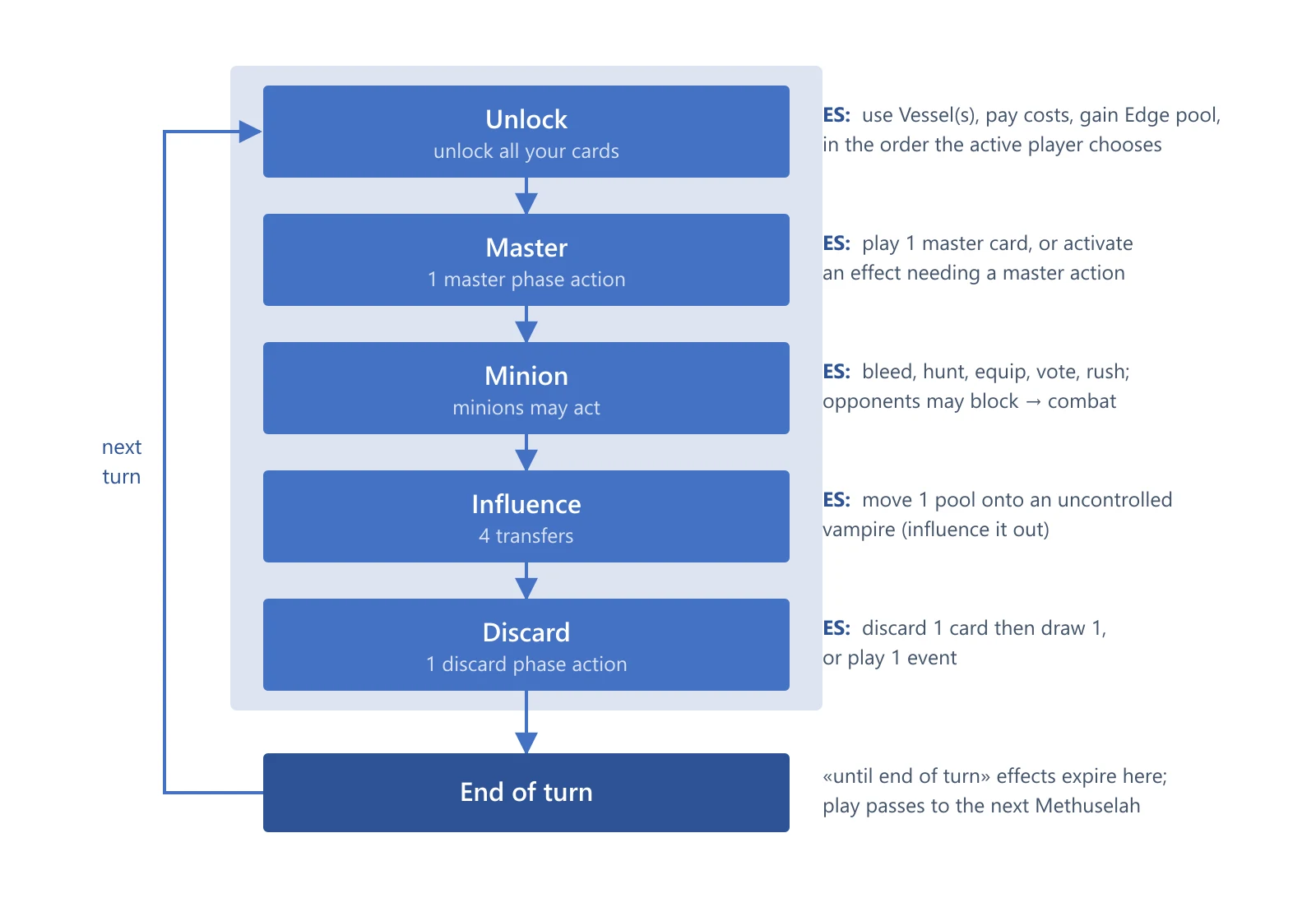
The five phases (descriptions from the official rulebook):
- Unlock: unlock all your cards; if you have the Edge, you may gain 1 pool.
- Master: you receive 1 master phase action (default): use it to play a master card (some cards change this number or give alternate uses).
- Minion: your ready minions take actions (taking an action locks the minion). Opponents’ ready minions may attempt to block, and blocking puts them in combat with the acting minion.
- Influence: you receive 4 transfers (default) to influence uncontrolled vampires into play (1 transfer = move 1 pool to an uncontrolled vampire; 4 transfers + 1 pool = move a vampire from your crypt to the uncontrolled region).
- Discard: you receive 1 discard phase action (default): discard a card and draw to replace it; or put 1 event card into play (no more than one per phase).
After the Discard phase, the turn ends and passes to the next Methuselah.
NOTE
Timing between phases (handy for veterans). Effects that last “until end of turn” expire at the end of the turn, i.e. after the Discard phase. Example: Dreams of the Sphinx (+2 hand size until end of turn) is still active during the Discard replacement and only ends once the turn is over.
The action
From the announcement of an action to after it resolves: block attempts, the two paths (successful or blocked action), the optional queued combat, and the return to the cycle to continue the action.
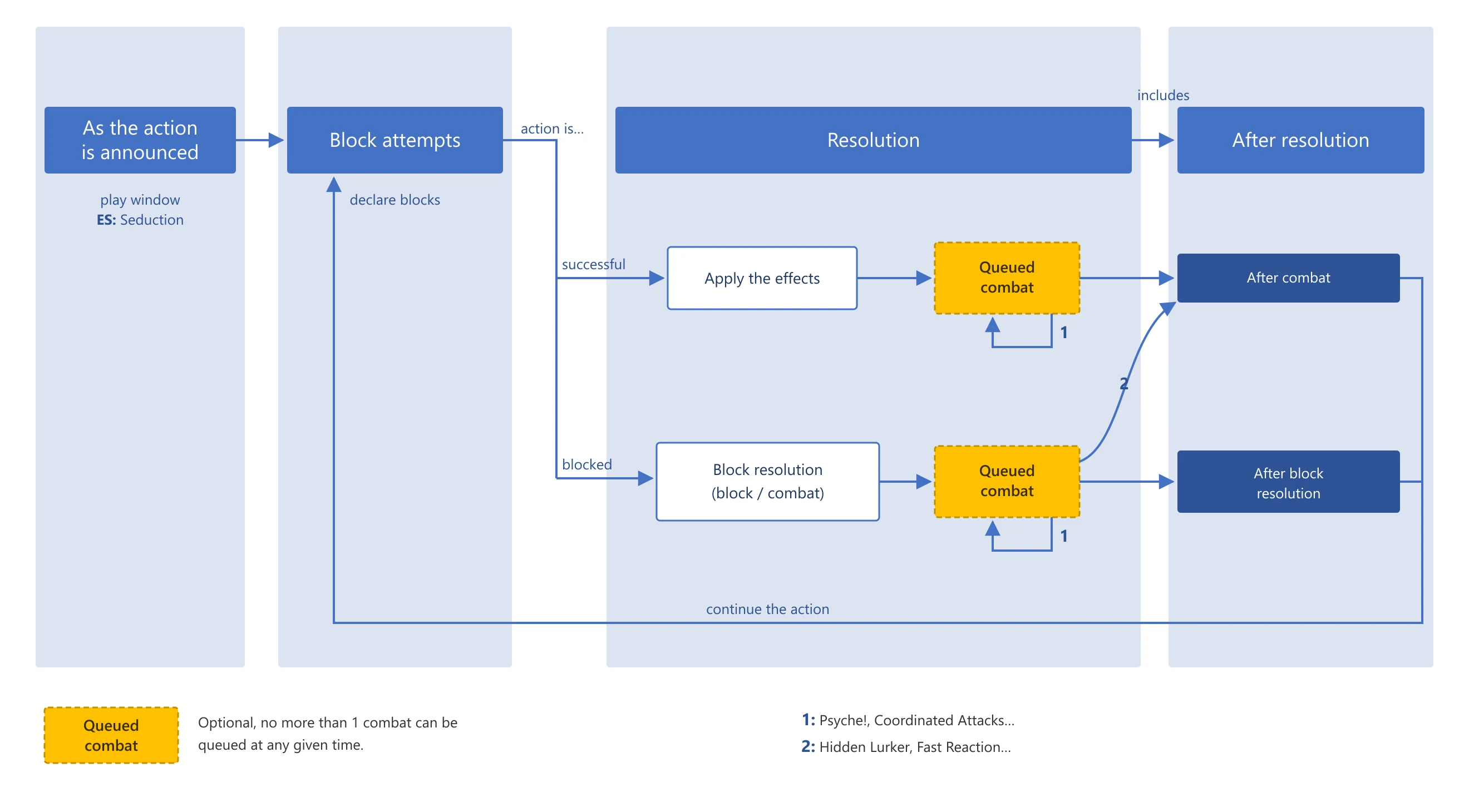
In short:
- As the action is announced: the dedicated play window that opens when the action is announced (cards like Seduction).
- Block attempts: the separate window where blocks are declared.
- If the action is successful (unblocked), its effects are applied.
- If it is blocked, you move to the block resolution (block / combat).
- Either branch may include a queued combat, optional, and no more than one at a time. Cards like Psyche! or Coordinated Attacks queue another one (1); cards like Hidden Lurker or Fast Reaction jump straight to “after combat” (2).
- After resolution the action continues its cycle (new block attempts, and so on).
Combat
A round of combat runs through seven steps. At the end of the round, combat may continue with a new round (press) or end.
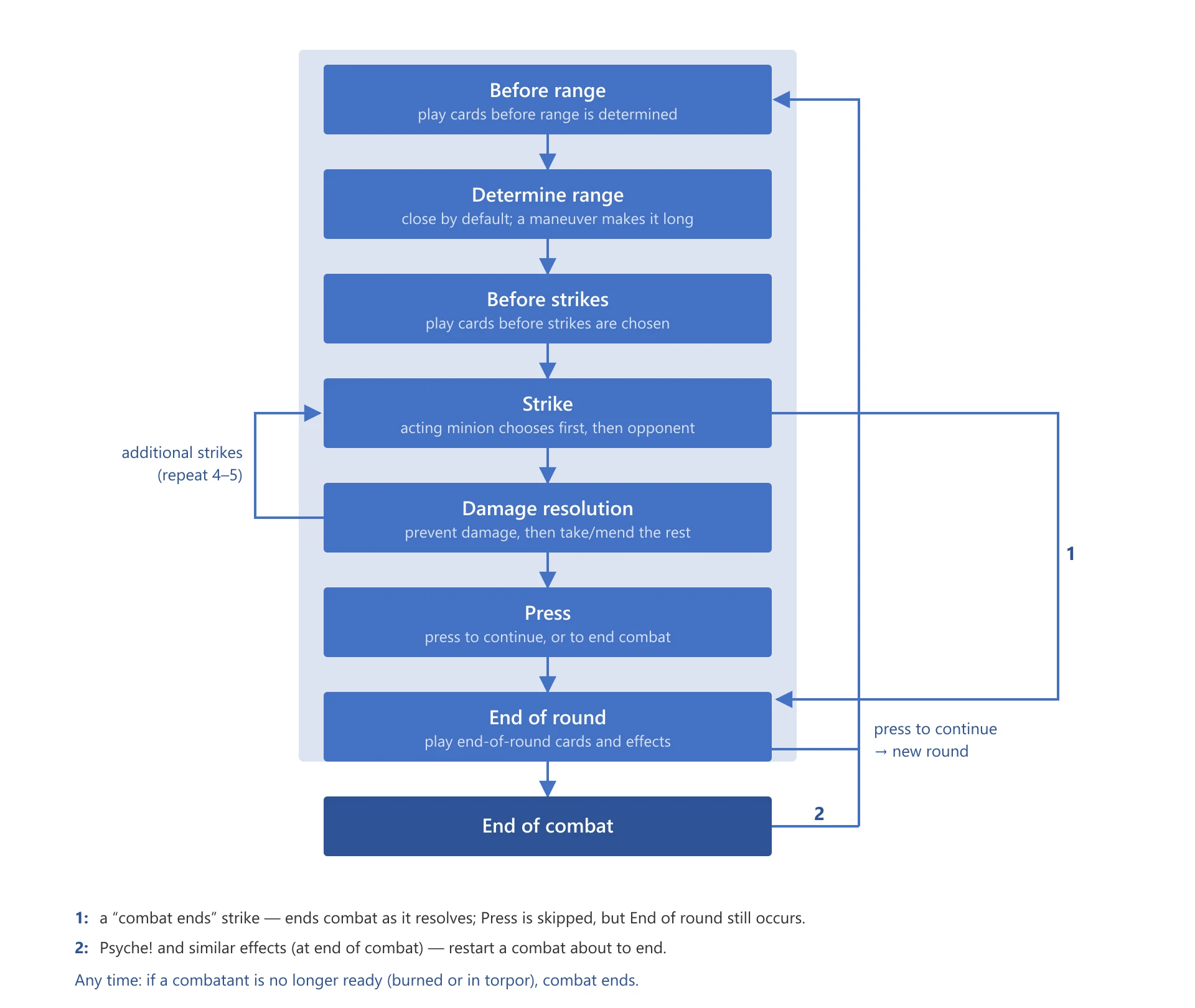
The seven steps:
- Before range: window for cards before range is chosen.
- Determine range: Close (default) or Long; maneuvers change it.
- Before strikes: cards playable after range, before choosing strikes.
- Strikes: the acting minion announces first; strikes resolve together (barring first strike effects, etc.).
- Damage resolution: first prevent damage, then handle the rest (by burning blood or life counters).
- Press: combatants decide whether to continue the combat or separate.
- End of round: end-of-round cards and effects are played.
Any additional strikes (granted by cards such as Additional Strike) repeat steps 4–5 (strike and damage resolution), one at a time, before the Press step. A minion cannot use more than one card or effect to gain additional strikes per round.
A new round begins if there is an uncancelled “press to continue”: one minion’s press is enough (the opponent may cancel it with their own press). Combat ends immediately if a combatant is burned or sent to torpor, at any point in the sequence.
Two interactions break the sequence (references 1 and 2 in the diagram):
- 1 - a strike with “combat ends”: combat ends as that strike resolves; the rest of strike resolution and the Press step are skipped, but the End of round step still occurs.
- 2 - Psyche! and similar effects (played at end of combat): conversely, they keep a combat going that would otherwise end, forcing a new round.
References
- VEKN Rulebook: the official rules.
- Official VEKN New Player Guide (A3, English): illustrated overview of zones, turn phases, combat, clans and disciplines.
- Running a V:TES demo: to use these diagrams during a demonstration.